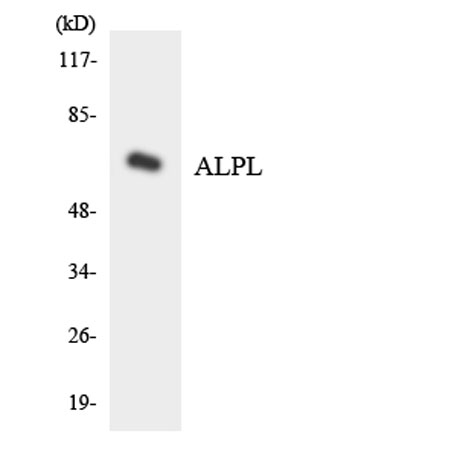

Western Blot: 1/500 - 1/2000. ELISA: 1/40000. Not yet tested in other applications.
Immunogen:
The antiserum was produced against synthesized peptide derived from human ALPL. AA range:201-250
Storage:
-20°C/1 year
Clonality:
Polyclonal
Isotype:
IgG
Concentration:
1 mg/ml
Observed Band:
70kD
GeneID:
249
Human Swiss-Prot No:
P05186
Cellular localization:
Cell membrane ; Lipid-anchor, GPI-anchor . Extracellular vesicle membrane ; Lipid-anchor, GPI-anchor . Mitochondrion membrane ; Lipid-anchor, GPI-anchor . Mitochondrion intermembrane space . Localizes to special class of extracellular vesicles, named matrix vesicles (MVs), which are released by osteogenic cells. Localizes to the mitochondria of thermogenic fat cells: tethered to mitochondrial membranes via a GPI-anchor and probably resides in the mitochondrion intermembrane space. .
Background:
This gene encodes a member of the alkaline phosphatase family of proteins. There are at least four distinct but related alkaline phosphatases: intestinal, placental, placental-like, and liver/bone/kidney (tissue non-specific). The first three are located together on chromosome 2, while the tissue non-specific form is located on chromosome 1. The product of this gene is a membrane bound glycosylated enzyme that is not expressed in any particular tissue and is, therefore, referred to as the tissue-nonspecific form of the enzyme. Alternative splicing results in multiple transcript variants, at least one of which encodes a preproprotein that is proteolytically processed to generate the mature enzyme. This enzyme may play a role in bone mineralization. Mutations in this gene have been linked to hypophosphatasia, a disorder that is characterized by hypercalcemia and skeletal defects. [prov